
Our Customer Stories
We're proud of what we build, but we are even prouder of the stories our customers share.
Our Customer Stories
We're proud of what we build, but we are even prouder of the stories our customers share.
Watch Their Stories of Transformation
Mark Johnson
(24-year homeowner)
"This has been a game changer for Debbie and I to be able to sit out on our porch, close these screens, and still look out in the river. I'm kicking myself that I didn't do it sooner."
Cary Paige
(Aquagrille Ponte Vedra Beach)
"The guests don't believe me when I say, 'Let's go outside.' When they're walking into the restaurant and it's cold, I say, 'Trust me, if you're not comfortable, I will buy you dinner.' That's where they want to sit now."
Tiffany Thomas
(Spain & Cooper Custom Homes)
"Our client was really looking to increase the flow from inside the home to outside... It allows you to really have more entertainment space, a cozy environment."
Freddie Wehbe
(Spurrier's Gridiron Grille)
"When those 65 seats are needed, we can use them now... It really is such a popular restaurant since the moment it opened."
Jim Michelli
(Sanford Verticals)
"These are, in my opinion, the highest quality outdoor screens you can buy. And they hold up to that in use day-to-day."
Melanie Frasier
(Titan Outdoor Solutions)
"They have screens from a competitor and those aren't working out for them. They're having a lot of troubles, a lot of issues with them."
Watch Their Stories of Transformation
Mark Johnson
(24-year homeowner)
"This has been a game changer for Debbie and I to be able to sit out on our porch, close these screens, and still look out in the river. I'm kicking myself that I didn't do it sooner."
Cary Paige
(Aquagrille Ponte Vedra Beach)
"The guests don't believe me when I say, 'Let's go outside.' When they're walking into the restaurant and it's cold, I say, 'Trust me, if you're not comfortable, I will buy you dinner.' That's where they want to sit now."
Tiffany Thomas
(Spain & Cooper Custom Homes)
"Our client was really looking to increase the flow from inside the home to outside... It allows you to really have more entertainment space, a cozy environment."
Freddie Wehbe
(Spurrier's Gridiron Grille)
"When those 65 seats are needed, we can use them now... It really is such a popular restaurant since the moment it opened."
Jim Michelli
(Sanford Verticals)
"These are, in my opinion, the highest quality outdoor screens you can buy. And they hold up to that in use day-to-day."
Melanie Frasier
(Titan Outdoor Solutions)
"They have screens from a competitor and those aren't working out for them. They're having a lot of troubles, a lot of issues with them."
Your Patio Is Not an Outdoor Room: What Most Homeowners Get Wrong About Outdoor Living
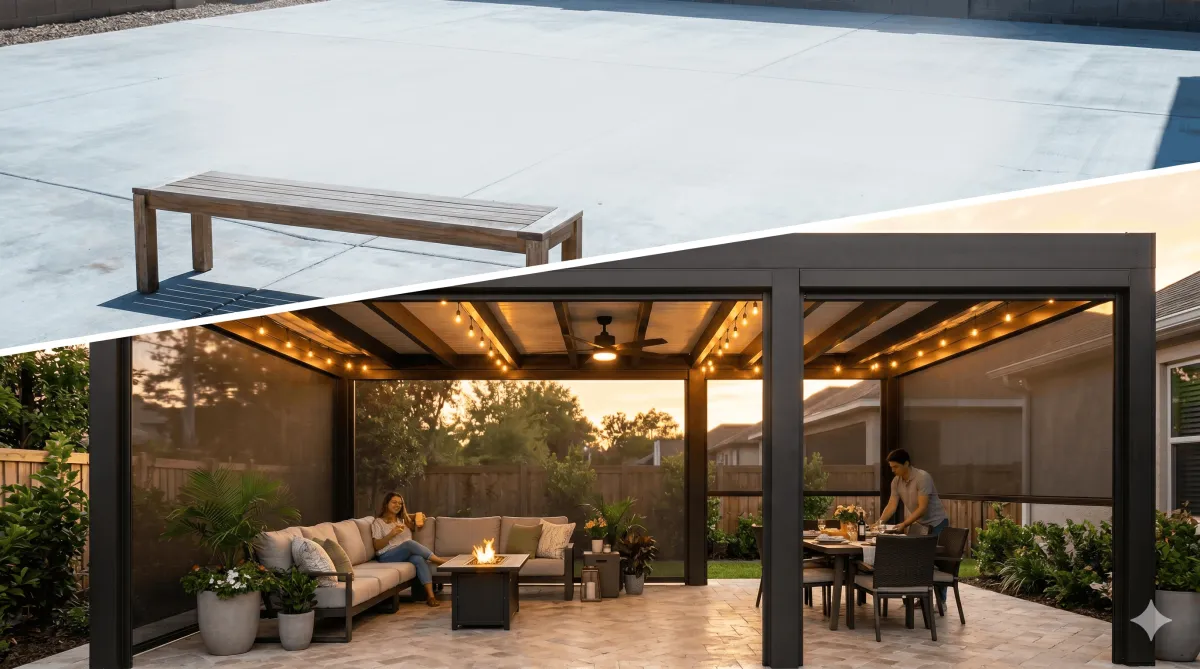
There is a moment that most homeowners experience but few can describe. It usually happens in the late afternoon, sometime between April and June, when the light is angled low enough to turn everything golden and the air carries just enough warmth to pull you toward the back door. You open it, step outside, and stand on the patio with a glass of something cold in your hand. The yard looks fine. The furniture is arranged. The planter you bought in February is blooming exactly the way the tag promised it would. And yet something is wrong. Not broken, not ugly, not obviously flawed; just wrong in a way you can feel but cannot name. The space is there. The square footage exists. But standing on it feels less like stepping into a room and more like stepping onto a stage where someone forgot to build the set.
This is the moment where most homeowners make their first critical mistake in outdoor living space design. They assume the problem is cosmetic. They buy another string of lights. They rearrange the furniture for the third time. They add a rug, a throw pillow, a citronella candle. And nothing changes, because the issue was never about what sits on the surface. The issue is that a patio, by itself, is not a room. It is a slab. And no amount of decoration can turn a slab into a space that feels like it belongs to your home.
[Explore Go-Fenetex Residential Solutions → https://gofenetex.com/residential]
The Feeling You Cannot Name
There is a concept in environmental psychology called "prospect-refuge theory," and it explains nearly everything about why your outdoor space feels incomplete. The theory, developed by geographer Jay Appleton in the 1970s, proposes that humans are drawn to spaces that offer both an open view outward and a sense of shelter overhead and behind. We inherited this preference from ancestors who needed to see approaching threats while remaining protected. Thousands of generations later, the instinct persists; it is the reason a covered porch at a lakeside restaurant feels inviting while an identical view from an open parking lot feels exposed.
Your patio is the parking lot.
That sounds harsh, but the comparison is instructive. An open patio offers prospect without refuge. The sky stretches overhead with nothing to mediate between you and the elements. There are no overhead beams to signal enclosure, no columns to define the edges, no visual boundary that tells your brain: this is a contained space, and you are safe within it. The furniture sits in the open like actors performing without a set. The space reads as transitional rather than intentional, a surface you cross on the way to somewhere else rather than a destination worth settling into.
This is the fundamental difference between a patio and an outdoor room. A patio is a horizontal surface. An outdoor room is a spatially defined volume with a floor, an implied ceiling, and boundaries that create the psychological cues of habitation. The distinction is not academic. It is the reason you feel restless on your patio when you felt completely at peace under the covered terrace at that resort in Scottsdale, and it is the reason no amount of outdoor living space design advice focused on furniture arrangement will ever solve the problem. The problem is architectural. The solution is structural.
[See Why Homeowners Choose Go-Fenetex → https://gofenetex.com/why-go-fenetex]
Why Decoration Cannot Fix What Structure Must Solve
The outdoor living industry has sold homeowners a comforting fiction for decades: that outdoor room ideas begin and end with product selection. Buy the right sectional. Choose the right fire pit. Install the right lighting. And the space will come together. This advice is not wrong, exactly, but it is incomplete in a way that costs homeowners thousands of dollars in the wrong sequence. It is like telling someone to hang curtains in a room that has no walls.
Consider what happens inside your home. Every room you love has a ceiling, a floor, and walls that define its proportions. The kitchen feels like a kitchen because of the cabinetry overhead and the countertops that create working boundaries. The living room feels like a living room because the ceiling plane creates a sense of enclosure and the seating arrangement exists within a space that has been architecturally defined. Remove the ceiling from any room in your house and the experience changes entirely. The furniture would still be there. The function would not.
Your outdoor space obeys the same rules. A backyard transformation that begins with furnishings before addressing the three structural layers of outdoor living is building from the wrong direction. It is possible to spend $10,000 on outdoor furniture, speakers, a grill, and a fire table and still feel, at the end of it all, that the space is not quite right. The candles still blow out in the wind. The cushions still soak in the rain. The mosquitoes still arrive at dusk with mechanical punctuality. And the sense of being "outside" rather than being "in a room" never fades because the structural prerequisites of spatial definition were never addressed.
[Discover Go-Fenetex Motorized Screens → https://gofenetex.com/residential]
The Three-Layer Model for Outdoor Living
The most effective approach to outdoor living space design is a layered one, and understanding the layers in order is the difference between a space that works and a space that almost works. There are three layers, each building on the one before it, and skipping or reversing them is the single most common mistake in outdoor space planning.
Layer One: The Foundation
The first layer is the ground beneath your feet. This is the paver patio, the hardscape, the surface that defines the footprint of your outdoor room. Concrete is the default, but it is not the only option, and for many homeowners it is not the best one. Pavers offer superior drainage, individual repairability, aesthetic versatility, and a surface quality that elevates the entire space. The foundation determines the dimensions of the room, the load-bearing capacity for what comes above, and the visual tone that every subsequent layer must complement. A well-chosen paver foundation does not just look better than poured concrete; it performs better under the thermal cycling, moisture exposure, and structural loads that outdoor living demands. If the floor is wrong, everything above it inherits the compromise.
Layer Two: The Structure
The second layer is the overhead element: the pergola, the structure that transforms a slab into a space. This is where spatial definition begins. The beams overhead create the implied ceiling. The columns define the room's edges. The proportions establish whether the space feels intimate or expansive, sheltered or open, casual or architectural. A pergola does more than provide shade, although shade is among its most immediate benefits. It provides the mounting infrastructure for everything the outdoor room will eventually need: fans for airflow, lights for ambiance, heaters for season extension, speakers for atmosphere, and, critically, the track systems for retractable motorized screens that seal the room against weather, insects, and wind. The pergola is a platform. What you build on it determines how the room performs.
Layer Three: The Completion
The third layer is the system that closes the gaps between structure and comfort. A pergola provides shade and definition, but it cannot stop rain from blowing sideways through the columns. It cannot prevent mosquitoes from arriving at golden hour. It cannot block the wind that scatters napkins and rattles glasses. It cannot offer privacy from the neighbor whose second-story deck overlooks your dining table. The completion layer is where Go-Fenetex retractable motorized screens enter the design. These screens mount directly to the pergola structure, deploy with a single button press through the Keder track retention system, and seal the space against every condition that drives homeowners indoors. When retracted, they disappear into a compact cassette housing, invisible and unobtrusive. When deployed, they transform an open pergola into an enclosed, climate-controlled, insect-free outdoor room. This is the layer that turns a three-season patio into a year-round living space. This is what makes the outdoor room actually work.
[Request a Free Outdoor Living Brochure → https://gofenetex.com/home-page]
What Happens When You Skip a Layer
The three-layer model is sequential, and the sequence matters. Each layer depends on the one beneath it, and skipping any single layer produces a predictable set of problems that no amount of spending on the remaining layers can solve.
Consider the pergola installed over a bare concrete slab that was poured without proper grading. The structure is beautiful, the beams are engineered, the proportions are right. But the slab beneath it pools water after every summer rain, creating standing puddles that take days to drain and breed mosquitoes directly beneath the space you built to escape them. The concrete cracks along expansion joints within two years because Florida's thermal cycling exceeds what the original pour was designed to handle. The pergola columns, anchored to an unstable base, begin to shift imperceptibly, and the Go-Fenetex screen tracks that require precise alignment can no longer maintain the tension that the One-Track system was engineered to deliver. The foundation was skipped. The consequences cascade upward.
Now consider the homeowner who installs beautiful pavers and fills the space with furniture but never adds the overhead structure. The pavers are stunning. The furniture is comfortable. And by 11 a.m. on any day between May and September, the surface temperature of the pavers exceeds 150 degrees Fahrenheit in direct sun and the furniture is untouchable. The space is usable for roughly four hours per day in summer: the brief windows before the sun climbs and after it descends. The homeowner spent $25,000 on a patio they can use 30 percent of the time. The structure was skipped. The usability collapses.
And finally, consider the homeowner who builds both the paver foundation and the pergola but never adds the completion layer. The space is defined, shaded, and architecturally beautiful. It is also open to every mosquito in the county, every sideways rainstorm, every gust of wind that turns a dinner party into a rescue operation for cloth napkins and wine glasses. The homeowner retreats indoors by 7:30 p.m. every evening, not because the space is ugly, but because it is uncomfortable. The completion was skipped. The room is gorgeous and uninhabitable.
[Explore Commercial Solutions by Go-Fenetex → https://gofenetex.com/commercial]
The Outdoor Room, Fully Imagined
Close your eyes for a moment and picture this. It is a Saturday in October. The air is cooling but not cold, carrying the first traces of what people in other climates would call autumn. You step through the back doors of your home onto a paver surface that catches the last of the day's warmth beneath your feet: travertine in a herringbone pattern that your wife spent three weeks choosing, and she was right, it sets the entire tone. Overhead, the aluminum pergola beams frame a sky that is shifting from blue to amber. Lights strung between the beams are beginning to glow, warm white, just enough to see by without competing with the sunset. A ceiling fan turns slowly, circulating air that smells like grilled rosemary and something your neighbor is burning in their fire pit two houses over.
And then the mosquitoes would arrive. Except they don't. Because you pressed a button on the wall as you walked out, and the Go-Fenetex retractable screens descended silently along the Keder tracks on three sides of the pergola, insect mesh that is nearly invisible from inside but absolute in its exclusion. The breeze still moves. The light still enters. The view is unchanged. But the space is sealed. Protected. Yours.
Your daughter is setting the table. Your son is arguing with your husband about whether the chicken needs another five minutes. The dog is asleep under the table in a position that suggests she has never been more comfortable in her life. Nobody is going inside. Nobody needs to. The outdoor room is working exactly the way it was designed to work, because it was built in the right order: foundation first, structure second, completion third.
This is not a fantasy reserved for resort properties and magazine covers. This is an outdoor entertaining space that follows the three-layer model, executed in the right sequence, with each layer engineered to support the one above it. This is what outdoor living space design looks like when nothing is skipped.
[Find a Go-Fenetex Dealer Near You → https://gofenetex.com/dealership]
Your Outdoor Space Deserves to Be Finished
You have felt the gap. You have stood on your patio and known, in a way that resists language, that the space is not what it should be. You may have tried to solve it with furniture, with lighting, with plants that bloom beautifully and change nothing about the fundamental experience of standing in an undefined outdoor area that your brain refuses to recognize as a room.
The problem is not your taste. The problem is not your budget. The problem is sequence: the three layers of outdoor living, built in order, each one completing the promise of the one before it. The first layer is the ground beneath your feet. That decision, pavers or concrete, is where everything begins. It determines what the space can become, what it can support, and how long it will last. In the next article, we examine that decision in detail: the real costs, the real engineering, and the real consequences of the foundation choice that most homeowners make without understanding what they are committing to.
Your patio is not a room. Not yet. But the path from slab to sanctuary is shorter than you think, and it starts with the ground.

Your Patio Is Not an Outdoor Room: What Most Homeowners Get Wrong About Outdoor Living
There is a moment that most homeowners experience but few can describe. It usually happens in the late afternoon, sometime between April and June, when the light is angled low enough to turn everything golden and the air carries just enough warmth to pull you toward the back door. You open it, step outside, and stand on the patio with a glass of something cold in your hand. The yard looks fine. The furniture is arranged. The planter you bought in February is blooming exactly the way the tag promised it would. And yet something is wrong. Not broken, not ugly, not obviously flawed; just wrong in a way you can feel but cannot name. The space is there. The square footage exists. But standing on it feels less like stepping into a room and more like stepping onto a stage where someone forgot to build the set.
This is the moment where most homeowners make their first critical mistake in outdoor living space design. They assume the problem is cosmetic. They buy another string of lights. They rearrange the furniture for the third time. They add a rug, a throw pillow, a citronella candle. And nothing changes, because the issue was never about what sits on the surface. The issue is that a patio, by itself, is not a room. It is a slab. And no amount of decoration can turn a slab into a space that feels like it belongs to your home.
[Explore Go-Fenetex Residential Solutions → https://gofenetex.com/residential]
The Feeling You Cannot Name
There is a concept in environmental psychology called "prospect-refuge theory," and it explains nearly everything about why your outdoor space feels incomplete. The theory, developed by geographer Jay Appleton in the 1970s, proposes that humans are drawn to spaces that offer both an open view outward and a sense of shelter overhead and behind. We inherited this preference from ancestors who needed to see approaching threats while remaining protected. Thousands of generations later, the instinct persists; it is the reason a covered porch at a lakeside restaurant feels inviting while an identical view from an open parking lot feels exposed.
Your patio is the parking lot.
That sounds harsh, but the comparison is instructive. An open patio offers prospect without refuge. The sky stretches overhead with nothing to mediate between you and the elements. There are no overhead beams to signal enclosure, no columns to define the edges, no visual boundary that tells your brain: this is a contained space, and you are safe within it. The furniture sits in the open like actors performing without a set. The space reads as transitional rather than intentional, a surface you cross on the way to somewhere else rather than a destination worth settling into.
This is the fundamental difference between a patio and an outdoor room. A patio is a horizontal surface. An outdoor room is a spatially defined volume with a floor, an implied ceiling, and boundaries that create the psychological cues of habitation. The distinction is not academic. It is the reason you feel restless on your patio when you felt completely at peace under the covered terrace at that resort in Scottsdale, and it is the reason no amount of outdoor living space design advice focused on furniture arrangement will ever solve the problem. The problem is architectural. The solution is structural.
[See Why Homeowners Choose Go-Fenetex → https://gofenetex.com/why-go-fenetex]
Why Decoration Cannot Fix What Structure Must Solve
The outdoor living industry has sold homeowners a comforting fiction for decades: that outdoor room ideas begin and end with product selection. Buy the right sectional. Choose the right fire pit. Install the right lighting. And the space will come together. This advice is not wrong, exactly, but it is incomplete in a way that costs homeowners thousands of dollars in the wrong sequence. It is like telling someone to hang curtains in a room that has no walls.
Consider what happens inside your home. Every room you love has a ceiling, a floor, and walls that define its proportions. The kitchen feels like a kitchen because of the cabinetry overhead and the countertops that create working boundaries. The living room feels like a living room because the ceiling plane creates a sense of enclosure and the seating arrangement exists within a space that has been architecturally defined. Remove the ceiling from any room in your house and the experience changes entirely. The furniture would still be there. The function would not.
Your outdoor space obeys the same rules. A backyard transformation that begins with furnishings before addressing the three structural layers of outdoor living is building from the wrong direction. It is possible to spend $10,000 on outdoor furniture, speakers, a grill, and a fire table and still feel, at the end of it all, that the space is not quite right. The candles still blow out in the wind. The cushions still soak in the rain. The mosquitoes still arrive at dusk with mechanical punctuality. And the sense of being "outside" rather than being "in a room" never fades because the structural prerequisites of spatial definition were never addressed.
[Discover Go-Fenetex Motorized Screens → https://gofenetex.com/residential]
The Three-Layer Model for Outdoor Living
The most effective approach to outdoor living space design is a layered one, and understanding the layers in order is the difference between a space that works and a space that almost works. There are three layers, each building on the one before it, and skipping or reversing them is the single most common mistake in outdoor space planning.
Layer One: The Foundation
The first layer is the ground beneath your feet. This is the paver patio, the hardscape, the surface that defines the footprint of your outdoor room. Concrete is the default, but it is not the only option, and for many homeowners it is not the best one. Pavers offer superior drainage, individual repairability, aesthetic versatility, and a surface quality that elevates the entire space. The foundation determines the dimensions of the room, the load-bearing capacity for what comes above, and the visual tone that every subsequent layer must complement. A well-chosen paver foundation does not just look better than poured concrete; it performs better under the thermal cycling, moisture exposure, and structural loads that outdoor living demands. If the floor is wrong, everything above it inherits the compromise.
Layer Two: The Structure
The second layer is the overhead element: the pergola, the structure that transforms a slab into a space. This is where spatial definition begins. The beams overhead create the implied ceiling. The columns define the room's edges. The proportions establish whether the space feels intimate or expansive, sheltered or open, casual or architectural. A pergola does more than provide shade, although shade is among its most immediate benefits. It provides the mounting infrastructure for everything the outdoor room will eventually need: fans for airflow, lights for ambiance, heaters for season extension, speakers for atmosphere, and, critically, the track systems for retractable motorized screens that seal the room against weather, insects, and wind. The pergola is a platform. What you build on it determines how the room performs.
Layer Three: The Completion
The third layer is the system that closes the gaps between structure and comfort. A pergola provides shade and definition, but it cannot stop rain from blowing sideways through the columns. It cannot prevent mosquitoes from arriving at golden hour. It cannot block the wind that scatters napkins and rattles glasses. It cannot offer privacy from the neighbor whose second-story deck overlooks your dining table. The completion layer is where Go-Fenetex retractable motorized screens enter the design. These screens mount directly to the pergola structure, deploy with a single button press through the Keder track retention system, and seal the space against every condition that drives homeowners indoors. When retracted, they disappear into a compact cassette housing, invisible and unobtrusive. When deployed, they transform an open pergola into an enclosed, climate-controlled, insect-free outdoor room. This is the layer that turns a three-season patio into a year-round living space. This is what makes the outdoor room actually work.
[Request a Free Outdoor Living Brochure → https://gofenetex.com/home-page]
What Happens When You Skip a Layer
The three-layer model is sequential, and the sequence matters. Each layer depends on the one beneath it, and skipping any single layer produces a predictable set of problems that no amount of spending on the remaining layers can solve.
Consider the pergola installed over a bare concrete slab that was poured without proper grading. The structure is beautiful, the beams are engineered, the proportions are right. But the slab beneath it pools water after every summer rain, creating standing puddles that take days to drain and breed mosquitoes directly beneath the space you built to escape them. The concrete cracks along expansion joints within two years because Florida's thermal cycling exceeds what the original pour was designed to handle. The pergola columns, anchored to an unstable base, begin to shift imperceptibly, and the Go-Fenetex screen tracks that require precise alignment can no longer maintain the tension that the One-Track system was engineered to deliver. The foundation was skipped. The consequences cascade upward.
Now consider the homeowner who installs beautiful pavers and fills the space with furniture but never adds the overhead structure. The pavers are stunning. The furniture is comfortable. And by 11 a.m. on any day between May and September, the surface temperature of the pavers exceeds 150 degrees Fahrenheit in direct sun and the furniture is untouchable. The space is usable for roughly four hours per day in summer: the brief windows before the sun climbs and after it descends. The homeowner spent $25,000 on a patio they can use 30 percent of the time. The structure was skipped. The usability collapses.
And finally, consider the homeowner who builds both the paver foundation and the pergola but never adds the completion layer. The space is defined, shaded, and architecturally beautiful. It is also open to every mosquito in the county, every sideways rainstorm, every gust of wind that turns a dinner party into a rescue operation for cloth napkins and wine glasses. The homeowner retreats indoors by 7:30 p.m. every evening, not because the space is ugly, but because it is uncomfortable. The completion was skipped. The room is gorgeous and uninhabitable.
[Explore Commercial Solutions by Go-Fenetex → https://gofenetex.com/commercial]
The Outdoor Room, Fully Imagined
Close your eyes for a moment and picture this. It is a Saturday in October. The air is cooling but not cold, carrying the first traces of what people in other climates would call autumn. You step through the back doors of your home onto a paver surface that catches the last of the day's warmth beneath your feet: travertine in a herringbone pattern that your wife spent three weeks choosing, and she was right, it sets the entire tone. Overhead, the aluminum pergola beams frame a sky that is shifting from blue to amber. Lights strung between the beams are beginning to glow, warm white, just enough to see by without competing with the sunset. A ceiling fan turns slowly, circulating air that smells like grilled rosemary and something your neighbor is burning in their fire pit two houses over.
And then the mosquitoes would arrive. Except they don't. Because you pressed a button on the wall as you walked out, and the Go-Fenetex retractable screens descended silently along the Keder tracks on three sides of the pergola, insect mesh that is nearly invisible from inside but absolute in its exclusion. The breeze still moves. The light still enters. The view is unchanged. But the space is sealed. Protected. Yours.
Your daughter is setting the table. Your son is arguing with your husband about whether the chicken needs another five minutes. The dog is asleep under the table in a position that suggests she has never been more comfortable in her life. Nobody is going inside. Nobody needs to. The outdoor room is working exactly the way it was designed to work, because it was built in the right order: foundation first, structure second, completion third.
This is not a fantasy reserved for resort properties and magazine covers. This is an outdoor entertaining space that follows the three-layer model, executed in the right sequence, with each layer engineered to support the one above it. This is what outdoor living space design looks like when nothing is skipped.
[Find a Go-Fenetex Dealer Near You → https://gofenetex.com/dealership]
Your Outdoor Space Deserves to Be Finished
You have felt the gap. You have stood on your patio and known, in a way that resists language, that the space is not what it should be. You may have tried to solve it with furniture, with lighting, with plants that bloom beautifully and change nothing about the fundamental experience of standing in an undefined outdoor area that your brain refuses to recognize as a room.
The problem is not your taste. The problem is not your budget. The problem is sequence: the three layers of outdoor living, built in order, each one completing the promise of the one before it. The first layer is the ground beneath your feet. That decision, pavers or concrete, is where everything begins. It determines what the space can become, what it can support, and how long it will last. In the next article, we examine that decision in detail: the real costs, the real engineering, and the real consequences of the foundation choice that most homeowners make without understanding what they are committing to.
Your patio is not a room. Not yet. But the path from slab to sanctuary is shorter than you think, and it starts with the ground.

Go-Fenetex creates premium motorized screens that provide hurricane-rated weather protection for residential and commercial spaces, backed by a lifetime warranty.


COMPANY
RETRACTABLE SOLUTIONS
RESOURCES
© 2025 Go-Fenetex Powered by Friends of Oatis
Go-Fenetex creates premium motorized screens that provide hurricane-rated weather protection for residential and commercial spaces, backed by a lifetime warranty.
COMPANY
SOLUTIONS
RESOURCES
© 2025 Go-Fenetex Powered by Friends of Oatis