
Our Customer Stories
We're proud of what we build, but we are even prouder of the stories our customers share.
Our Customer Stories
We're proud of what we build, but we are even prouder of the stories our customers share.
Watch Their Stories of Transformation
Mark Johnson
(24-year homeowner)
"This has been a game changer for Debbie and I to be able to sit out on our porch, close these screens, and still look out in the river. I'm kicking myself that I didn't do it sooner."
Cary Paige
(Aquagrille Ponte Vedra Beach)
"The guests don't believe me when I say, 'Let's go outside.' When they're walking into the restaurant and it's cold, I say, 'Trust me, if you're not comfortable, I will buy you dinner.' That's where they want to sit now."
Tiffany Thomas
(Spain & Cooper Custom Homes)
"Our client was really looking to increase the flow from inside the home to outside... It allows you to really have more entertainment space, a cozy environment."
Freddie Wehbe
(Spurrier's Gridiron Grille)
"When those 65 seats are needed, we can use them now... It really is such a popular restaurant since the moment it opened."
Jim Michelli
(Sanford Verticals)
"These are, in my opinion, the highest quality outdoor screens you can buy. And they hold up to that in use day-to-day."
Melanie Frasier
(Titan Outdoor Solutions)
"They have screens from a competitor and those aren't working out for them. They're having a lot of troubles, a lot of issues with them."
Watch Their Stories of Transformation
Mark Johnson
(24-year homeowner)
"This has been a game changer for Debbie and I to be able to sit out on our porch, close these screens, and still look out in the river. I'm kicking myself that I didn't do it sooner."
Cary Paige
(Aquagrille Ponte Vedra Beach)
"The guests don't believe me when I say, 'Let's go outside.' When they're walking into the restaurant and it's cold, I say, 'Trust me, if you're not comfortable, I will buy you dinner.' That's where they want to sit now."
Tiffany Thomas
(Spain & Cooper Custom Homes)
"Our client was really looking to increase the flow from inside the home to outside... It allows you to really have more entertainment space, a cozy environment."
Freddie Wehbe
(Spurrier's Gridiron Grille)
"When those 65 seats are needed, we can use them now... It really is such a popular restaurant since the moment it opened."
Jim Michelli
(Sanford Verticals)
"These are, in my opinion, the highest quality outdoor screens you can buy. And they hold up to that in use day-to-day."
Melanie Frasier
(Titan Outdoor Solutions)
"They have screens from a competitor and those aren't working out for them. They're having a lot of troubles, a lot of issues with them."
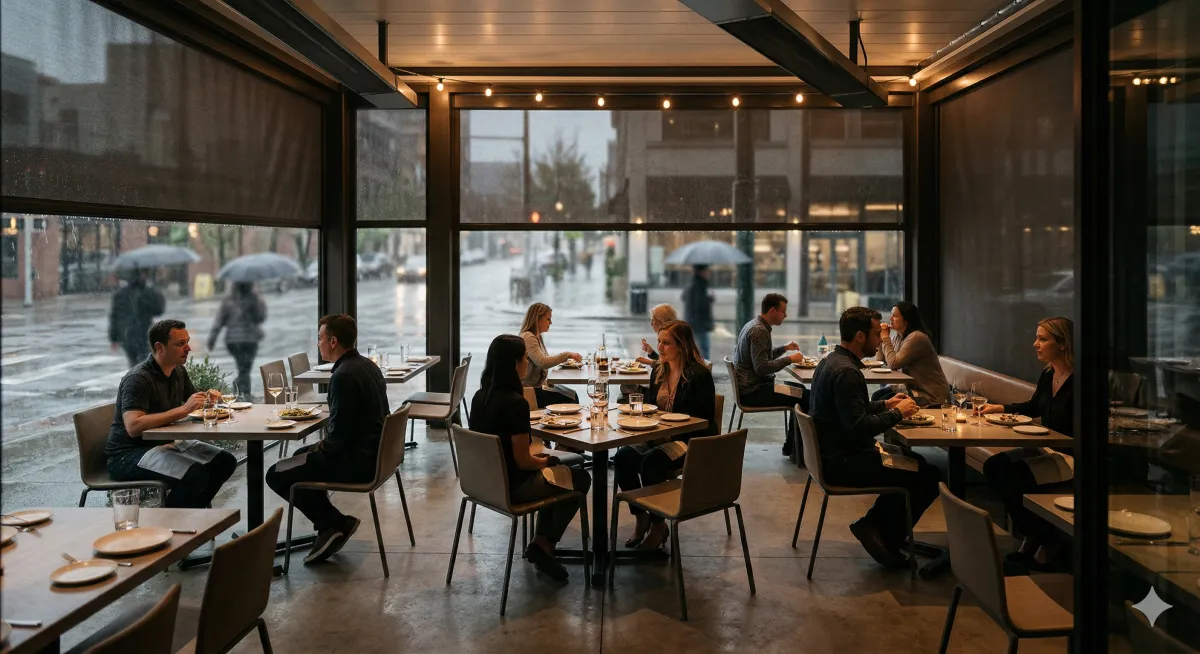
Year-Round Patio Seating: How Smart Venues Are Winning with Screens
The patio is the most profitable square footage in your building.
On a good night, it generates more revenue per seat than the dining room. The ambiance is better. The guest satisfaction is higher. The photos guests post on social media, the ones that fill tables for months afterward, are almost always taken outside.
But here's the paradox every hospitality operator knows: the space that produces the most when conditions cooperate is also the space that produces nothing when they don't.
A single afternoon storm can erase $4,000 in patio revenue. A week of wind-blown evenings can quietly suppress guest satisfaction scores that took months to build. A mosquito-heavy dusk can send a table of four inside before dessert, and their friends hear about it before the check arrives.
The smartest venues in the hospitality industry have stopped accepting this equation. They're not closing their patios when the weather turns. They're pressing a button.
This is the story of how restaurants, resorts, wedding venues, and bars are turning year-round patio seating from an aspiration into a competitive advantage, and how motorized screens for restaurants from Go Fenetex are making it happen.
The Shift: From Seasonal Bonus to Core Strategy
For years, outdoor dining was treated as a seasonal perk. Something nice to have when the weather cooperated. A bonus that padded the numbers in spring and fall, disappeared during the rainy months, and came with an asterisk every time a cloud appeared on the radar.
That mindset is over.
As Restaurant News reported, heading into 2026, restaurants are investing in covered outdoor dining not as an add-on, but as a core part of their business strategy. The drivers are clear: unpredictable weather, rising operational costs, and guest expectations that have permanently evolved. Today's diners expect outdoor spaces to be comfortable, intentional, and usable regardless of the forecast.
The numbers reinforce the shift. According to Fast Casual, a well-designed outdoor seating area can increase restaurant revenue by up to 30 percent. And additional research suggests that a thoughtful investment in outdoor infrastructure can generate returns of two to three times the initial cost. When patio seating is treated as a revenue-generating asset rather than a weather-dependent accessory, the math works decisively in the operator's favor.
But here's the catch: to capture that revenue reliably, the patio has to work reliably. And for most venues, "reliably" means solving the three problems that shut patios down: rain, bugs, and wind.
Motorized screens for restaurants solve all three, simultaneously, in about thirty seconds.
Inside the Venue: What Changes When Screens Go In
Let's walk through four different commercial spaces and see what year-round patio seating actually looks like in practice.
The coastal restaurant. A 60-seat waterfront dining patio in Southwest Florida. Before screens: roughly 40 percent of spring and summer dinner services were disrupted or cut short by afternoon storms. The owner estimated $80,000 to $100,000 in lost annual patio revenue from weather alone, not counting the cancellations that came from guests who checked the forecast and decided not to risk it. After commercial outdoor screens from Go Fenetex: the patio operates through every afternoon storm. The screens descend, the rain stays out, the service continues. Revenue recovery in the first season covered the installation cost. By the second season, every storm that hits during dinner service is pure recovered revenue.
The boutique resort. A beachfront property with poolside dining and a rooftop event terrace. Before screens: outdoor events required weather contingency clauses, and three outdoor wedding receptions had been partially relocated indoors in a single season, each costing the venue in guest satisfaction and referral potential. After motorized screens: the resort eliminated weather contingencies for outdoor events. The rooftop terrace became a guaranteed, rain-or-shine venue. Bookings for outdoor receptions increased by a measurable margin in the first year, and the poolside dining area went from a four-season aspiration to a four-season reality. The screens became part of the property's marketing language: "Outdoor elegance, guaranteed."
The craft brewery. A 30-seat patio attached to a taproom. Before screens: the patio was the brewery's best asset from 5 to 7 p.m., when the after-work crowd arrived. But mosquitoes at dusk thinned the crowd by 7:30, and wind from the parking lot made the space uncomfortable on gusty evenings. Third pours dropped. Average dwell time was under 90 minutes. After screens: bugs eliminated. Wind blocked. Average dwell time extended past two hours, and the per-guest spend increased accordingly. The patio that used to empty at dusk now stays full until close, and the screens have become a conversation piece that guests mention in online reviews.
The wedding venue. An estate property with a ceremony garden and a reception pavilion. Before screens: every outdoor wedding contract included an indoor backup clause, and the venue spent significant staff hours managing weather contingencies, repositioning furniture, and communicating plan changes to anxious couples. The "what if it rains?" question dominated every initial consultation. After venue motorized screens: the question disappeared. The pavilion became a guaranteed outdoor reception space. Couples stopped asking about Plan B because Plan A now worked in every condition. Staff time freed up. Consultation-to-booking conversions improved. And the venue's social media filled with reception photos taken under screens during rainstorms, the kind of atmospheric, unforgettable images that book the next fifty weddings.
GO FENETEX MOTORIZED SCREENS
Turn Your Patio into a Year-Round Revenue Center Rain, bugs, wind, heat: one button and every seat stays full, every night, every season. Go Fenetex commercial screens protect your revenue and elevate the guest experience.
Explore Commercial Solutions →
The Guest Experience Multiplier
Revenue protection is the obvious case for motorized screens for restaurants and venues. But the operators who have lived with screens for a full season describe something deeper: a multiplier effect on the guest experience that compounds over time.
Ambiance control. Screens transform a patio from an open, exposed area into a defined room. The wind calms. The bugs vanish. The candles stay lit. The sound of conversation replaces the sound of traffic. Guests don't just stay longer. They relax more deeply, order more thoughtfully, and leave more satisfied. For venues that depend on atmosphere, from fine dining restaurants to resort pool decks, this shift in experiential quality is worth as much as the recovered revenue.
Review and reputation impact. Guest satisfaction drives online reviews, and online reviews drive bookings. A venue where the patio consistently delivers a comfortable, elegant experience generates a review profile that reflects that consistency. The occasional "we loved sitting outside during the rainstorm" review is the kind of organic marketing that money can't buy and that competitors without screens can't replicate.
Private event confidence. For any venue that hosts events, the weather contingency conversation is a friction point that costs bookings. Every couple who asks "what if it rains?" is expressing a hesitation that, in some percentage of cases, sends them to an indoor venue instead. Motorized screens for wedding venues eliminate that hesitation entirely. The outdoor space is guaranteed. The booking conversion improves. And the events themselves produce the kind of dramatic, weather-defying photography that fills social feeds and future inquiry forms.
Staff efficiency. The scramble to close a patio, the calls to rearrange reservations, the time spent resetting tables after a storm: all of it disappears. Staff that used to manage weather contingencies now focus on service. The operational smoothness of a patio that works in every condition creates a calmer, more efficient team, and guests feel the difference.
The Investment Case for How to Make a Restaurant Patio Year-Round
Here's the business case, distilled to its essentials.
A venue with a 40-seat patio and an average check of $60 generates $2,400 per full turn. If weather disrupts just two weekend services per month during the five-month storm season, the annual revenue loss is $48,000 to $60,000 or more, depending on how many midweek and brunch services are also affected. Factor in lost private event revenue and suppressed guest satisfaction, and the annual cost of an unprotected patio can exceed $100,000.
The cost of motorized screens for restaurants varies by patio size, configuration, and installation requirements. But for most commercial operators, the screens pay for themselves within the first full season. After that, every disrupted service that would have cost revenue is instead a normal, profitable night.
The best screens for resort outdoor dining and commercial applications are engineered for the demands of hospitality: high-cycle deployment (screens going up and down multiple times per day), wind and rain resistance under commercial-grade conditions, and an aesthetic that enhances rather than detracts from the venue's design. Go Fenetex commercial screens, manufactured in the United States by Fenetex, are built to this standard. The proprietary Keder track retention system locks the fabric into engineered aluminum channels under tension, holding secure through storms and sustained use. The screens retract into compact cassette housings that are virtually invisible when not deployed, preserving the open-air aesthetic that makes the patio appealing in the first place.
ONE TRACK SCREENS
Hospitality-Grade Performance, Built by Fenetex One Track motorized screen systems handle the high-cycle demands of restaurants, resorts, and event venues. Retractable. Reliable. Backed by a lifetime warranty.
Explore One Track Screens →
The Competitive Edge Nobody Else Has
Here's the reality of the competitive landscape in hospitality: most venues with outdoor seating are still weather-dependent. They close when it rains. They lose covers when the wind picks up. They watch guests leave at dusk when the bugs arrive.
Every one of those moments is a competitive opening for the venue that has screens.
The restaurant where the patio stays full during a thunderstorm earns the reputation. The resort where the poolside dinner continues through a tropical shower earns the booking. The wedding venue that can promise an outdoor reception in any condition earns the contract. And the bar where guests stay two hours instead of one because the screens keep the mosquitoes out earns the margin that their neighbors are leaving on the table.
Year-round patio seating isn't just an operational improvement. It's a positioning statement: we take our outdoor experience seriously enough to guarantee it. In a market where guests have more choices than ever and margins get thinner every season, that guarantee is a differentiator that competitors can't match without making the same investment.
The venues that move first earn the advantage longest.
Ready to turn your patio into a year-round competitive advantage? Explore commercial solutions from Go Fenetex → gofenetex.com/commercial
It Starts with One Season
Somewhere this year, a venue is going to install motorized screens for restaurants on their patio and watch the numbers change.
The storms will still come. The bugs will still swarm at dusk. The wind will still gust on Friday nights. But the patio will stay full. The revenue will stay on the books. The guests will stay happy. And the staff will stop watching the sky and start focusing on what they do best: creating an experience worth coming back to.
That venue could be yours.
One season. One investment. Year-round revenue.

Year-Round Patio Seating: How Smart Venues Are Winning with Screens
The patio is the most profitable square footage in your building.
On a good night, it generates more revenue per seat than the dining room. The ambiance is better. The guest satisfaction is higher. The photos guests post on social media, the ones that fill tables for months afterward, are almost always taken outside.
But here's the paradox every hospitality operator knows: the space that produces the most when conditions cooperate is also the space that produces nothing when they don't.
A single afternoon storm can erase $4,000 in patio revenue. A week of wind-blown evenings can quietly suppress guest satisfaction scores that took months to build. A mosquito-heavy dusk can send a table of four inside before dessert, and their friends hear about it before the check arrives.
The smartest venues in the hospitality industry have stopped accepting this equation. They're not closing their patios when the weather turns. They're pressing a button.
This is the story of how restaurants, resorts, wedding venues, and bars are turning year-round patio seating from an aspiration into a competitive advantage, and how motorized screens for restaurants from Go Fenetex are making it happen.
The Shift: From Seasonal Bonus to Core Strategy
For years, outdoor dining was treated as a seasonal perk. Something nice to have when the weather cooperated. A bonus that padded the numbers in spring and fall, disappeared during the rainy months, and came with an asterisk every time a cloud appeared on the radar.
That mindset is over.
As Restaurant News reported, heading into 2026, restaurants are investing in covered outdoor dining not as an add-on, but as a core part of their business strategy. The drivers are clear: unpredictable weather, rising operational costs, and guest expectations that have permanently evolved. Today's diners expect outdoor spaces to be comfortable, intentional, and usable regardless of the forecast.
The numbers reinforce the shift. According to Fast Casual, a well-designed outdoor seating area can increase restaurant revenue by up to 30 percent. And additional research suggests that a thoughtful investment in outdoor infrastructure can generate returns of two to three times the initial cost. When patio seating is treated as a revenue-generating asset rather than a weather-dependent accessory, the math works decisively in the operator's favor.
But here's the catch: to capture that revenue reliably, the patio has to work reliably. And for most venues, "reliably" means solving the three problems that shut patios down: rain, bugs, and wind.
Motorized screens for restaurants solve all three, simultaneously, in about thirty seconds.
Inside the Venue: What Changes When Screens Go In
Let's walk through four different commercial spaces and see what year-round patio seating actually looks like in practice.
The coastal restaurant. A 60-seat waterfront dining patio in Southwest Florida. Before screens: roughly 40 percent of spring and summer dinner services were disrupted or cut short by afternoon storms. The owner estimated $80,000 to $100,000 in lost annual patio revenue from weather alone, not counting the cancellations that came from guests who checked the forecast and decided not to risk it. After commercial outdoor screens from Go Fenetex: the patio operates through every afternoon storm. The screens descend, the rain stays out, the service continues. Revenue recovery in the first season covered the installation cost. By the second season, every storm that hits during dinner service is pure recovered revenue.
The boutique resort. A beachfront property with poolside dining and a rooftop event terrace. Before screens: outdoor events required weather contingency clauses, and three outdoor wedding receptions had been partially relocated indoors in a single season, each costing the venue in guest satisfaction and referral potential. After motorized screens: the resort eliminated weather contingencies for outdoor events. The rooftop terrace became a guaranteed, rain-or-shine venue. Bookings for outdoor receptions increased by a measurable margin in the first year, and the poolside dining area went from a four-season aspiration to a four-season reality. The screens became part of the property's marketing language: "Outdoor elegance, guaranteed."
The craft brewery. A 30-seat patio attached to a taproom. Before screens: the patio was the brewery's best asset from 5 to 7 p.m., when the after-work crowd arrived. But mosquitoes at dusk thinned the crowd by 7:30, and wind from the parking lot made the space uncomfortable on gusty evenings. Third pours dropped. Average dwell time was under 90 minutes. After screens: bugs eliminated. Wind blocked. Average dwell time extended past two hours, and the per-guest spend increased accordingly. The patio that used to empty at dusk now stays full until close, and the screens have become a conversation piece that guests mention in online reviews.
The wedding venue. An estate property with a ceremony garden and a reception pavilion. Before screens: every outdoor wedding contract included an indoor backup clause, and the venue spent significant staff hours managing weather contingencies, repositioning furniture, and communicating plan changes to anxious couples. The "what if it rains?" question dominated every initial consultation. After venue motorized screens: the question disappeared. The pavilion became a guaranteed outdoor reception space. Couples stopped asking about Plan B because Plan A now worked in every condition. Staff time freed up. Consultation-to-booking conversions improved. And the venue's social media filled with reception photos taken under screens during rainstorms, the kind of atmospheric, unforgettable images that book the next fifty weddings.
GO FENETEX MOTORIZED SCREENS
Turn Your Patio into a Year-Round Revenue Center Rain, bugs, wind, heat: one button and every seat stays full, every night, every season. Go Fenetex commercial screens protect your revenue and elevate the guest experience.
Explore Commercial Solutions →
The Guest Experience Multiplier
Revenue protection is the obvious case for motorized screens for restaurants and venues. But the operators who have lived with screens for a full season describe something deeper: a multiplier effect on the guest experience that compounds over time.
Ambiance control. Screens transform a patio from an open, exposed area into a defined room. The wind calms. The bugs vanish. The candles stay lit. The sound of conversation replaces the sound of traffic. Guests don't just stay longer. They relax more deeply, order more thoughtfully, and leave more satisfied. For venues that depend on atmosphere, from fine dining restaurants to resort pool decks, this shift in experiential quality is worth as much as the recovered revenue.
Review and reputation impact. Guest satisfaction drives online reviews, and online reviews drive bookings. A venue where the patio consistently delivers a comfortable, elegant experience generates a review profile that reflects that consistency. The occasional "we loved sitting outside during the rainstorm" review is the kind of organic marketing that money can't buy and that competitors without screens can't replicate.
Private event confidence. For any venue that hosts events, the weather contingency conversation is a friction point that costs bookings. Every couple who asks "what if it rains?" is expressing a hesitation that, in some percentage of cases, sends them to an indoor venue instead. Motorized screens for wedding venues eliminate that hesitation entirely. The outdoor space is guaranteed. The booking conversion improves. And the events themselves produce the kind of dramatic, weather-defying photography that fills social feeds and future inquiry forms.
Staff efficiency. The scramble to close a patio, the calls to rearrange reservations, the time spent resetting tables after a storm: all of it disappears. Staff that used to manage weather contingencies now focus on service. The operational smoothness of a patio that works in every condition creates a calmer, more efficient team, and guests feel the difference.
The Investment Case for How to Make a Restaurant Patio Year-Round
Here's the business case, distilled to its essentials.
A venue with a 40-seat patio and an average check of $60 generates $2,400 per full turn. If weather disrupts just two weekend services per month during the five-month storm season, the annual revenue loss is $48,000 to $60,000 or more, depending on how many midweek and brunch services are also affected. Factor in lost private event revenue and suppressed guest satisfaction, and the annual cost of an unprotected patio can exceed $100,000.
The cost of motorized screens for restaurants varies by patio size, configuration, and installation requirements. But for most commercial operators, the screens pay for themselves within the first full season. After that, every disrupted service that would have cost revenue is instead a normal, profitable night.
The best screens for resort outdoor dining and commercial applications are engineered for the demands of hospitality: high-cycle deployment (screens going up and down multiple times per day), wind and rain resistance under commercial-grade conditions, and an aesthetic that enhances rather than detracts from the venue's design. Go Fenetex commercial screens, manufactured in the United States by Fenetex, are built to this standard. The proprietary Keder track retention system locks the fabric into engineered aluminum channels under tension, holding secure through storms and sustained use. The screens retract into compact cassette housings that are virtually invisible when not deployed, preserving the open-air aesthetic that makes the patio appealing in the first place.
ONE TRACK SCREENS
Hospitality-Grade Performance, Built by Fenetex One Track motorized screen systems handle the high-cycle demands of restaurants, resorts, and event venues. Retractable. Reliable. Backed by a lifetime warranty.
Explore One Track Screens →
The Competitive Edge Nobody Else Has
Here's the reality of the competitive landscape in hospitality: most venues with outdoor seating are still weather-dependent. They close when it rains. They lose covers when the wind picks up. They watch guests leave at dusk when the bugs arrive.
Every one of those moments is a competitive opening for the venue that has screens.
The restaurant where the patio stays full during a thunderstorm earns the reputation. The resort where the poolside dinner continues through a tropical shower earns the booking. The wedding venue that can promise an outdoor reception in any condition earns the contract. And the bar where guests stay two hours instead of one because the screens keep the mosquitoes out earns the margin that their neighbors are leaving on the table.
Year-round patio seating isn't just an operational improvement. It's a positioning statement: we take our outdoor experience seriously enough to guarantee it. In a market where guests have more choices than ever and margins get thinner every season, that guarantee is a differentiator that competitors can't match without making the same investment.
The venues that move first earn the advantage longest.
Ready to turn your patio into a year-round competitive advantage? Explore commercial solutions from Go Fenetex → gofenetex.com/commercial
It Starts with One Season
Somewhere this year, a venue is going to install motorized screens for restaurants on their patio and watch the numbers change.
The storms will still come. The bugs will still swarm at dusk. The wind will still gust on Friday nights. But the patio will stay full. The revenue will stay on the books. The guests will stay happy. And the staff will stop watching the sky and start focusing on what they do best: creating an experience worth coming back to.
That venue could be yours.
One season. One investment. Year-round revenue.

Go-Fenetex creates premium motorized screens that provide hurricane-rated weather protection for residential and commercial spaces, backed by a lifetime warranty.


COMPANY
RETRACTABLE SOLUTIONS
RESOURCES
© 2025 Go-Fenetex Powered by Friends of Oatis
Go-Fenetex creates premium motorized screens that provide hurricane-rated weather protection for residential and commercial spaces, backed by a lifetime warranty.
COMPANY
SOLUTIONS
RESOURCES
© 2025 Go-Fenetex Powered by Friends of Oatis