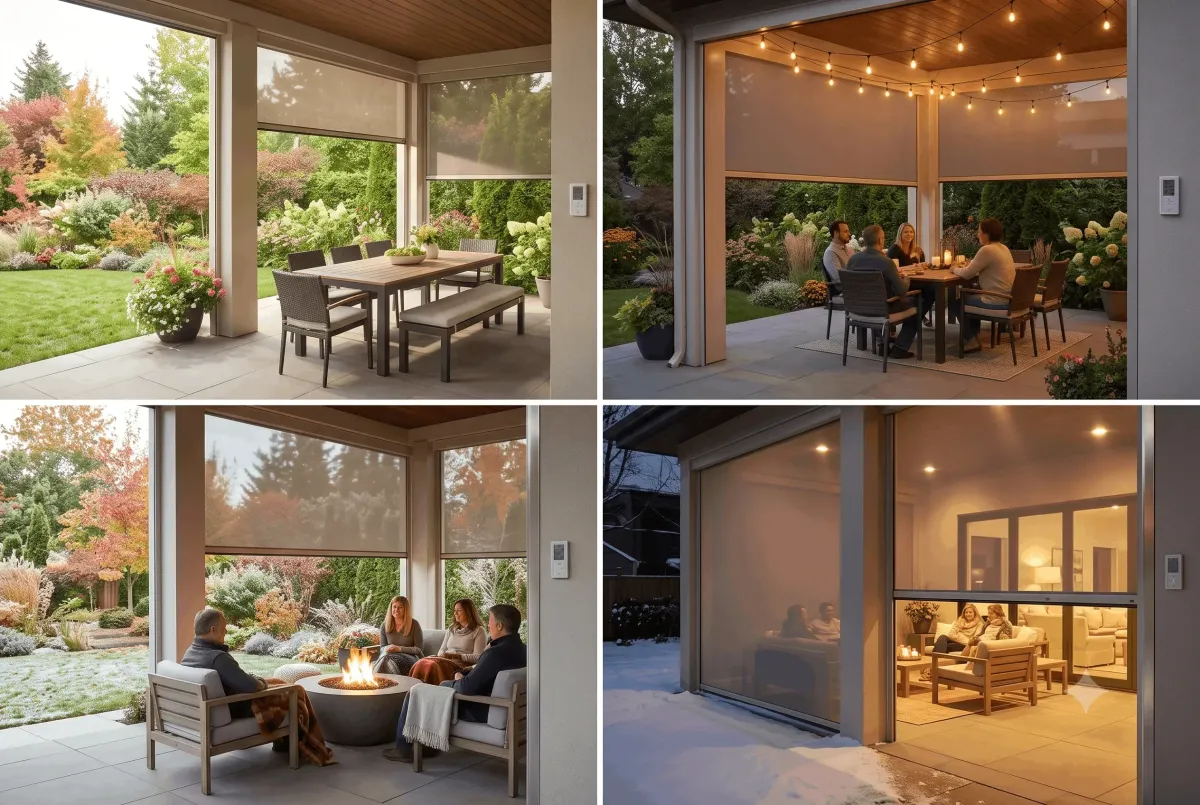
How Motorized Screens Turn a Seasonal Patio Into a Year-Round Outdoor Room
Here is a number that should bother you: four. That is the number of months the average homeowner uses their outdoor living space, in a climate that technically allows outdoor use for ten or eleven months of the year. The discrepancy between what is possible and what actually happens is not a matter of personal preference or laziness. It is a matter of infrastructure. The outdoor space was built for summer. It was not built for year-round. And the gap between a summer patio and a year-round outdoor room is not a bigger grill or a thicker cushion. It is the environmental envelope that allows the space to function when conditions are less than perfect, which, in the real world, describes the majority of the calendar.
Go-Fenetex motorized screens are the technology that closes this gap, transforming year-round outdoor living from an aspiration into an operational reality. Not by changing the weather, but by changing the outdoor room's relationship to it. When vinyl screens are deployed along the pergola perimeter, the outdoor room becomes a semi-enclosed space where temperature, wind, and moisture are managed rather than endured. Combined with the heating, ventilation, and lighting infrastructure that the pergola supports, the screened outdoor room extends from a four-month summer space to a ten-month living environment that serves the homeowner in every season except the most extreme weeks of winter, and in Florida, even those weeks are often comfortable within the screen envelope.
[Explore Go-Fenetex Residential Solutions → https://gofenetex.com/residential]
Month by Month: What Your Outdoor Room Could Look Like
January and February
The coolest months. In Florida, daytime temperatures typically range from the mid-50s to low 70s, with occasional cold fronts dropping into the 40s. Without screens, the outdoor space is exposed to wind chill that makes 55 degrees feel like 45 and drives the homeowner indoors despite perfectly manageable air temperatures. With Go-Fenetex vinyl screens deployed, the outdoor room blocks the wind, traps solar heat during the afternoon, and creates a micro-environment where an infrared heater mounted to the pergola beam can raise the enclosed temperature by 10 to 15 degrees. Sunday brunch in January becomes an outdoor event. Morning coffee in February happens under the pergola, not behind the kitchen window looking at it.
March and April
The transition months. Temperatures climb, rain becomes more frequent, and the insects begin their seasonal emergence. Without screens, March is pleasant but April introduces the rain disruptions that preview summer. With screens, the homeowner deploys vinyl during afternoon storms and insect mesh during the increasingly warm evenings. The outdoor room is used daily rather than conditionally. The extend outdoor season screens investment begins paying its return in reclaimed evenings during months that were previously surrendered.
May Through September
Peak season. Heat, humidity, daily thunderstorms, and maximum insect activity. This is the period when most homeowners assume their outdoor space should perform, and it is also the period when unscreened spaces perform worst. Without screens, the homeowner retreats indoors by 6:30 p.m. when the mosquitoes arrive and cancels outdoor plans every afternoon when the 3 p.m. thunderstorm rolls through. With Go-Fenetex dual screens deployed, the insect mesh runs continuously from late afternoon through evening, the vinyl screens deploy during storms, and the outdoor room operates as a four-season outdoor room regardless of what the weather does outside its perimeter.
October and November
The reward months. Temperatures moderate, humidity drops, and the quality of outdoor light shifts to the warm, golden tones that make every patio photograph look like a real estate listing. These are the months that most homeowners cite as their favorite for outdoor living, and they are also the months most commonly lost to the assumption that "outdoor season is over." With screens and a heater, October and November evenings become the best outdoor dining experiences of the year: cool air, warm light, no bugs, no wind, screens deployed just enough to hold the warmth.
December
Holiday month. In Florida, December temperatures range from the low 50s to mid-70s, and many days are perfect for outdoor entertaining. With vinyl screens deployed and a heater running, the outdoor room hosts holiday gatherings that would otherwise be crammed into the dining room. The space that was built for summer becomes the room that hosts Christmas.
[See Why Homeowners Choose Go-Fenetex → https://gofenetex.com/why-go-fenetex]
The Technology Behind Year-Round Comfort
The transition from seasonal to year-round outdoor living motorized screens requires more than the screens themselves. It requires the integrated system that the three-layer model has been building toward across this entire series.
The pergola provides the structural platform: mounting points for infrared heaters that warm the space during cool months, ceiling fans that circulate air during warm months, and lighting that extends the usable hours into the evening year-round. The Go-Fenetex retractable screens provide the environmental envelope: vinyl screens that block wind and retain warmth during cool months, insect mesh that excludes bugs during warm months, and both deployed simultaneously during the shoulder seasons when conditions require multiple protections. The pavers provide the thermal foundation: a surface that absorbs and radiates solar heat during cool months and remains walkable during warm months.
Together, the three layers create a four-season outdoor room that functions as an extension of the home's climate-controlled interior. The screens do not make the space identical to an indoor room; they make it better than an indoor room, because the air is fresh, the light is natural, and the view is real.
[Find a Go-Fenetex Dealer Near You → https://gofenetex.com/dealership]
The Math of Lost Months
Consider the financial dimension of season extension. A homeowner who builds a $60,000 outdoor room (pavers, pergola, furniture, landscaping) and uses it four months per year is paying $15,000 per month of use in year one. A homeowner who extends that usage to ten months through Go-Fenetex motorized screens is paying $6,000 per month of use. The screens did not change the construction cost. They changed the denominator. More months of use means a lower cost per month, a higher return on the investment, and a space that justifies its expense through daily contribution to the homeowner's quality of life rather than seasonal, weather-dependent availability.
The calculation becomes even more compelling when viewed over the life of the investment. Over twenty years, the four-month homeowner gets eighty months of outdoor room use. The ten-month homeowner gets two hundred months. The construction cost is the same. The screen investment adds perhaps $15,000 to $30,000 to the total project. The difference in lifetime use is 120 additional months of a space that was already built and already paid for.
The screens do not create the outdoor room. The pavers and pergola do that. The screens unlock it. They remove the conditions that limit its use and extend its contribution to the homeowner's life from a seasonal amenity to a year-round living space.
[Explore Commercial Solutions by Go-Fenetex → https://gofenetex.com/commercial]
What Dealers and Homeowners Report After Installation
The most consistent observation from Go-Fenetex dealers is not about the product's performance, although performance is universally praised. It is about the behavior change. Homeowners who used their outdoor space weekends-only in summer begin using it daily, year-round. The morning coffee ritual moves outside. The evening wind-down moves outside. Working from home, on pleasant days, moves outside. The outdoor room stops being a special-occasion space and becomes part of the home's daily circulation pattern.
This behavior shift is the truest measure of the year-round outdoor living motorized screens investment. The financial return matters, and it is real. The property value increase matters, and it is measurable. But the return that homeowners describe with the most conviction is the simplest one: they live outside now. Not sometimes. Not when conditions cooperate. They live outside because the conditions always cooperate, because the screens made it so.
[See Go-Fenetex Home Page → https://gofenetex.com/home-page]
Your Outdoor Room, Every Season
You built the foundation. You built the structure. You added the screens. The outdoor room is complete, and it works not four months but ten, not in perfect weather but in all weather, not for special occasions but for daily life. The next question is the one that every homeowner asks when they realize the scope of their investment: what is the return? Not just in enjoyment, which is immeasurable, but in dollars, which are not. What do pavers, pergolas, and motorized screens actually return in property value? The answer, examined with real market data in our next article, may be the most compelling argument in the entire series.
