The Property Value Equation: What Outdoor Living Improvements Actually Return on Investment
FULL BLOG POST
The question arrives at the same moment in every outdoor living project: the moment the total is visible, all three layers added together, pavers plus pergola plus screens, and the number sitting at the bottom of the estimate is large enough to trigger the internal audit that every homeowner conducts before writing a check that size. The question is always the same: "Will I get this money back?" It is asked by practical homeowners and aspirational homeowners alike, by the partner who championed the project and the partner who needed convincing, by homeowners planning to stay for twenty years and homeowners who might sell in five. The question is universal because the anxiety behind it is universal: the fear that a large expenditure on something beautiful might not also be something smart.
Here is the answer, supported by market data, real estate intelligence, and the accumulated experience of thousands of outdoor living installations: yes. But not in the way most homeowners expect. The outdoor living space ROI home value equation is not a simple "spend X, recover Y at resale." It is a dual-return investment that pays dividends in two currencies simultaneously, daily quality of life and long-term property appreciation, and the homeowners who understand both currencies make the decision with confidence rather than anxiety.
[Explore Go-Fenetex Residential Solutions → https://gofenetex.com/residential]
The First Return: Daily Use
The return that is hardest to quantify and easiest to feel is the daily return. The outdoor room that works year-round, sealed against rain and bugs by Go-Fenetex motorized screens, shaded by the pergola, grounded by the pavers, delivers value every time it is used. That value is measured in the meals eaten outside rather than in the kitchen, the mornings spent with coffee under the pergola rather than behind the kitchen window, the evenings where the family gathers in the outdoor room rather than dispersing to separate screens in separate indoor rooms, and the weekends where guests arrive and stay because the space is comfortable rather than making excuses to leave because it is not.
This return cannot be captured on a balance sheet, but it can be estimated through a proxy: the cost per use. A $75,000 outdoor room used four months per year at three uses per week generates approximately 48 uses per year. Over twenty years, that is 960 uses at a cost of $78 per use. The same outdoor room, extended to ten months of use through motorized screens (a total investment of, say, $90,000 including the screens), generates approximately 120 uses per year. Over twenty years, that is 2,400 uses at a cost of $37.50 per use. The screens doubled the return by doubling the usage.
Homeowners do not think of their outdoor space in cost-per-use terms, but this framework is useful for the partner-persuasion conversation that accompanies every major home investment. The screens are not an added cost. They are a usage multiplier that reduces the effective cost of the entire project by increasing the denominator.
[See Why Homeowners Choose Go-Fenetex → https://gofenetex.com/why-go-fenetex]
The Second Return: Property Value
The second return is financial and measurable. Do pavers increase home value? Does a pergola increase home value? Do motorized screens increase home value? The data from multiple sources converges on a consistent answer: yes, with qualifications that matter.
Foundation ROI: Pavers
The National Association of Realtors' Remodeling Impact Report ranks outdoor living improvements among the highest-recovery renovations. Paver patios specifically outperform poured concrete in resale contexts because they signal intentional investment rather than default construction. Real estate agents in Sun Belt markets report that professionally installed paver patios with quality materials recover 60 to 80 percent of their cost at resale, with the recovery rate increasing in neighborhoods where outdoor living is a buyer priority. The visual impact in listing photographs is significant: a paver patio reads as "upgraded" while concrete reads as "original," and that perception influences buyer engagement within the first seconds of viewing an online listing.
Structure ROI: Pergola
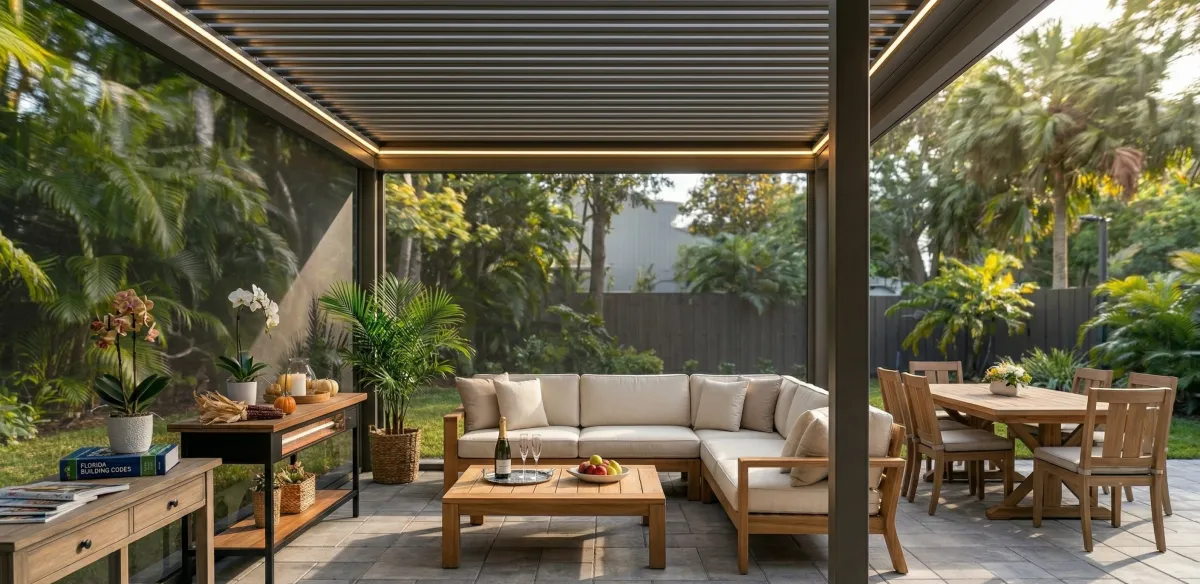
The pergola ROI is driven by two mechanisms: perceived square footage expansion and aspirational photography. A pergola-covered outdoor room appears in listing photographs as an additional living space, a room that buyers can envision using immediately. This perceived expansion of livable square footage influences the buyer's valuation of the property, even though the pergola does not add to the home's appraised square footage in the traditional sense. Real estate professionals consistently cite pergolas and covered outdoor spaces among the top three features that generate buyer interest in Sun Belt markets, alongside updated kitchens and primary suite renovations.
Completion ROI: Go-Fenetex Motorized Screens
Motorized screens home value addition is the most nuanced of the three layers. Screens are a less familiar product category for most buyers, which means their value is not immediately recognizable the way a pergola or paver patio is. However, when the outdoor room is presented as a complete, climate-controlled, year-round living space, the screens become the differentiator that elevates the property above comparable listings. A home with a screened outdoor room is not just a home with a patio. It is a home with an additional functional room, one that works in rain, resists insects, blocks wind, and provides privacy on demand.
For commercial properties, particularly restaurants and hospitality venues, the motorized screens home value calculation is replaced by a revenue calculation: Go-Fenetex screens allow outdoor seating to operate in conditions that would otherwise force closure, directly expanding revenue-generating capacity. Restaurants with Go-Fenetex screened patios report that previously unusable rainy or cold days become full-service dining opportunities, with the screen investment recovering through increased covers within one to two seasons.
[Find a Go-Fenetex Dealer Near You → https://gofenetex.com/dealership]
The Dual-Return Framework
The outdoor living return on investment is not a single number. It is two numbers that compound over time.
The first number is the daily return: the accumulation of experiences, meals, conversations, mornings, and evenings that the outdoor room provides over the homeowner's tenure. This return begins immediately upon completion and accumulates every day the space is used. It cannot be recovered at resale because it has already been received. It is the reason you built the space.
The second number is the resale return: the portion of the investment that is recovered when the property is sold. This return is realized once, at the end of ownership, and its magnitude depends on the quality of the installation, the local market's valuation of outdoor living, and the presentation of the space in the listing.
The dual-return framework reframes the investment conversation from "How much will I get back?" to "How much value will I receive?" The first question focuses only on the resale return and ignores the daily return entirely. The second question captures both currencies. The homeowner who builds a $90,000 outdoor room, uses it for fifteen years of daily enjoyment, and recovers 65 percent of the cost at resale has not lost 35 percent of their investment. They have received fifteen years of daily value and then recovered a majority of the construction cost.
This is the framework that resolves the investment anxiety. The outdoor room pays you twice: first in how you live, then in what you recover. Both returns are real. Both returns have value.
[Explore Commercial Solutions by Go-Fenetex → https://gofenetex.com/commercial]
Making the Investment With Confidence
The three-layer outdoor room is a significant investment, and the homeowner who approaches it with eyes open, understanding both the daily and resale returns, makes the decision from a position of confidence rather than anxiety.
The phased approach reduces the financial commitment per phase while building value incrementally. Phase one, the pavers, establishes the foundation and delivers immediate aesthetic and property value improvement. Phase two, the pergola, adds the structure that defines the space and creates the platform for future completion. Phase three, the Go-Fenetex motorized screens, completes the room and unlocks the year-round usage that maximizes both the daily and resale returns.
Each phase stands alone as a value-adding improvement. Each phase enhances the returns of the phases that preceded it. And the complete three-layer room, pavers plus pergola plus screens, represents the highest-return outdoor living investment available to homeowners in Sun Belt and coastal markets: a functional, year-round, climate-controlled outdoor room that delivers daily value and appreciates the property.
[See Go-Fenetex Home Page → https://gofenetex.com/home-page]
The Investment Is Justified, Now Execute
Eleven weeks of this series have built the knowledge, the framework, and the conviction. You understand the three layers. You understand the materials, the engineering, the permitting, the limitations, and the solutions. You understand the financial return in both currencies. What remains is the decision, and the plan to execute it.
The final article in this series brings everything together: the three-layer model, the phased execution plan, the budget framework, and the single decision that transforms an outdoor space from seasonal slab to year-round room. That article is next, and it is the one that turns knowledge into action.
