What a Pergola Cannot Do Alone (And the One Addition That Changes Everything)
The pergola has been up for six weeks. Six weeks of compliments from the neighbors, six weeks of watching the shadow patterns shift across the pavers as the sun tracks from east to west, six weeks of sitting beneath the beams in the morning with coffee and feeling, for the first time, that the outdoor space is no longer a slab but a room. The first month was perfect. The second month introduced reality.
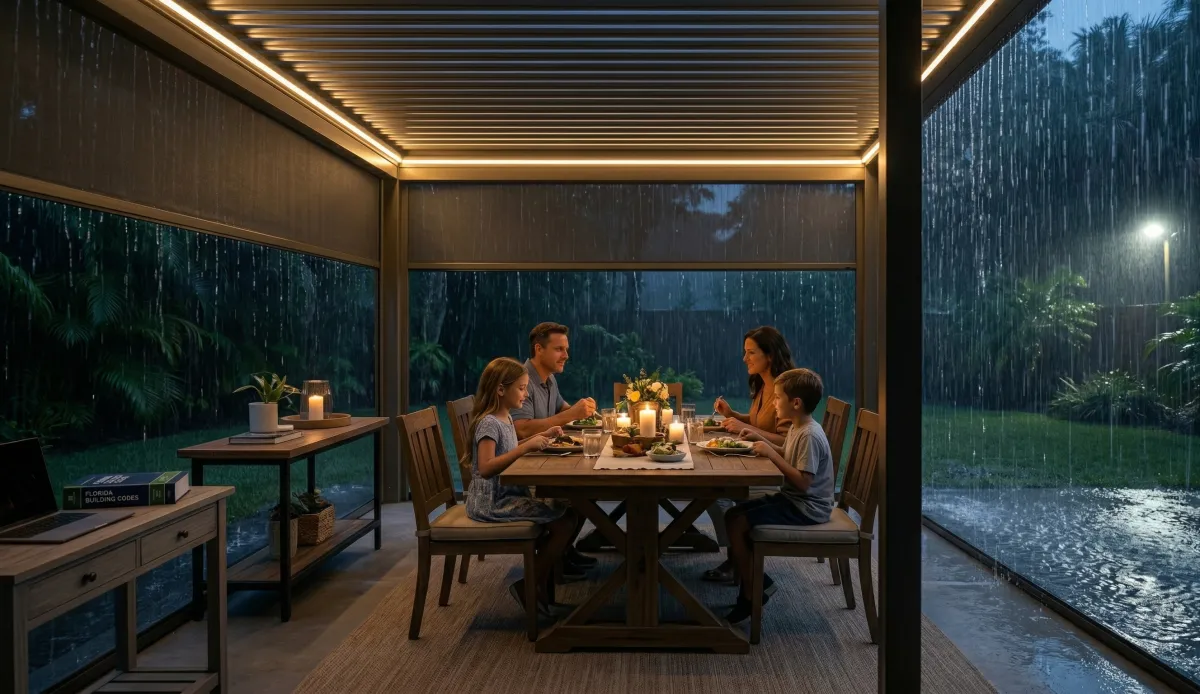
It started with the rain. Not a dramatic storm, just a steady, slanted drizzle that the wind pushed sideways through the open columns on a Tuesday evening when you had planned to eat outside. The table was set. The food was ready. And the rain, arriving not from above where the pergola could address it but from the side where the pergola could not, ended the evening before it began. The next encounter was the mosquitoes, appearing at 6:47 p.m. with the kind of precision that suggests they consult a calendar. Then the wind, not a gale but enough to scatter napkins and make candle flames dance sideways. Then the neighbor, whose new second-story deck offers a panoramic view of your dining table from twenty feet above.
Each of these intrusions, individually, is tolerable. Collectively, they are the reason the pergola, which should be the centerpiece of your outdoor life, is used primarily for morning coffee before the conditions arrive and weekend lunches when the weather cooperates. The pergola is not the problem. The pergola is exactly what it was designed to be: an overhead structure that provides shade and spatial definition. The problem is that shade and spatial definition are not enough. The outdoor room needs one more layer. It needs the system that closes the gaps between structure and comfort.
[Explore Go-Fenetex Residential Solutions → https://gofenetex.com/residential]
Five Gaps a Pergola Cannot Close
The five limitations of an open pergola are not design failures. They are architectural realities that every pergola owner encounters, and understanding them as a system rather than as individual annoyances is the key to solving them efficiently.
The insect gap. A shaded pergola with food, human warmth, and carbon dioxide output is an insect magnet. Mosquitoes detect CO2 from over 150 feet. No-see-ums navigate through spaces that would stop a mosquito. Flies find any unprotected food surface within minutes. The pergola creates the conditions that make outdoor dining possible and simultaneously creates the conditions that attract every species evolved to exploit those conditions.
The weather gap. Overhead coverage stops vertical rain. It does not stop wind-driven rain, which in Florida arrives laterally during the convective thunderstorms that define summer afternoons. A pergola with a solid or louvered roof will keep you dry from above; the first fifteen-mph gust sends the rain sideways through the columns and onto the table.
The wind gap. Even on clear days, moderate wind through an open pergola disrupts the comfort of the space. Napkins scatter, lightweight plates shift, candle flames extinguish, and conversations compete with the ambient noise of wind moving through the structure. The sensation of being "in" a room dissolves when the air moves through it as freely as if the walls did not exist.
The sun gap. A pergola provides overhead shade. It does not address the low-angle sun that enters from the sides during the morning and late afternoon hours, precisely when most homeowners want to use the space. West-facing pergolas are particularly affected, as the setting sun pours directly into the open structure during the evening hours that are most valuable for outdoor dining and entertaining.
The privacy gap. Open columns mean open sight lines. In neighborhoods with adjacent properties, elevated decks, or multi-story homes, the pergola offers no visual barrier between your outdoor room and the surrounding homes. For homeowners who value the sense of seclusion that makes outdoor relaxation possible, this gap is not minor. It is the difference between feeling at home and feeling observed.
[See Why Homeowners Choose Go-Fenetex → https://gofenetex.com/why-go-fenetex]
The Completion Layer: Go-Fenetex Motorized Retractable Screens
Every gap listed above is closed by a single system: motorized retractable screens that mount directly to the pergola structure and deploy on command to create a sealed perimeter around the outdoor room. Go-Fenetex motorized screens for pergola spaces are engineered specifically for this application, and their design addresses every limitation of the open structure while preserving everything homeowners love about the pergola's openness.
The system consists of a screen cassette housing mounted to the pergola header beam, containing a fabric roll that deploys downward along precision-machined aluminum side tracks. The fabric edges are reinforced with a Keder bead, a nylon cord wrapped in durable material, that slides into the track's machined groove and creates a self-reinforcing seal: the harder the wind pushes, the more securely the fabric is held. This is the Keder track retention system, and it is the engineering that allows Go-Fenetex screens to maintain their seal in wind conditions that would dislodge any conventional screen.
The One-Track spring tensioning technology maintains constant fabric tension as the screen deploys and retracts, ensuring a smooth, wrinkle-free surface that resists wind deflection and maintains a clean visual line. The result is a screen that looks taut and finished when deployed, not sagging or rippling like fabric hung between posts.
Go-Fenetex offers dual-screen configurations that address multiple conditions independently. An insect mesh screen provides airflow and visibility while creating an impenetrable barrier to mosquitoes, no-see-ums, and flying insects. A vinyl weather screen creates a solid barrier against rain, wind, and cold while maintaining visibility. Both screens operate independently within the same track system, allowing the homeowner to deploy insect mesh on clear evenings, vinyl screens during storms, or both for maximum protection.
The fabric itself, OmegaTex, is manufactured by Twitchell and engineered for continuous outdoor exposure in demanding coastal environments. UV-resistant, tear-resistant, and rated for the thermal cycling and humidity that Florida delivers year-round.
[Find a Go-Fenetex Dealer Near You → https://gofenetex.com/dealership]
One Button, Every Problem Solved
The operational reality of Go-Fenetex motorized screens for pergola spaces is disarmingly simple. The homeowner presses a button on a wall switch, a remote control, a smartphone app, or issues a voice command through smart home integration. The screens deploy silently from the cassette housing, guided by the Keder tracks, tensioned by the One-Track system, and within 60 seconds the outdoor room is sealed. No ladders. No manual panels. No seasonal installation and removal. No visible hardware when the screens are retracted; the cassette housing is compact and integrated into the pergola's header profile.
When conditions change, the process reverses with the same button press. The screens retract into the cassette, the Keder bead slides cleanly out of the track, and the pergola returns to its open configuration. The homeowner transitions between open-air pergola and enclosed outdoor room as frequently and as effortlessly as opening and closing a window.
[Explore Commercial Solutions by Go-Fenetex → https://gofenetex.com/commercial]
What Homeowners Say After the Screens Go In
The transformation is not incremental. Homeowners who add Go-Fenetex retractable screens to their pergola consistently describe the change in terms that go beyond functional improvement. They describe it as a change in how they live. Evening dinners move outside permanently. Saturday mornings become outdoor mornings regardless of weather. Hosting shifts from "we hope it doesn't rain" to "it doesn't matter if it rains." The space that was used 30 percent of the time is suddenly used 90 percent of the time, because the conditions that drove the homeowner indoors no longer exist.
Dealers report the same observation: the most common response from homeowners after installation is not "the screens work well" but "I wish we had done this sooner." The pergola was an improvement. The screens were a transformation. Together, they are a room.
[See Go-Fenetex Home Page → https://gofenetex.com/home-page]
The Outdoor Room, Completed
This is the pivot point of the entire series. For seven weeks, we have built the outdoor room layer by layer: the pavers that create the foundation, the engineering that protects it, the material choices that define its aesthetic, the pergola that provides structure, the permits that legitimize it, and now, the screens that complete it. The three-layer model is no longer theoretical. It is the room you are sitting in.
The next phase of this series explores what that completed room means in practice: how a single motorized screen system solves the four persistent enemies of outdoor living, how screens extend a seasonal patio into a year-round room, and how the total investment, pavers plus pergola plus screens, returns value in both daily enjoyment and long-term property appreciation. The outdoor room is built. Now we live in it.
